Call Now!

What Is STC Rating in Acoustic Partitions? Complete Guide
When designing offices, conference rooms, hotels, banquet halls, classrooms or other commercial spaces, controlling unwanted noise is an important requirement. A partition may successfully divide one large room into smaller areas, but if conversations and other sounds easily pass through it, the space may not provide the privacy users need.
This is where STC Rating becomes important.
STC, or Sound Transmission Class, is one of the most commonly used measurements for understanding how effectively a wall or acoustic partition reduces airborne sound transmission. For architects, consultants, builders and facility managers, understanding STC ratings can help in selecting the right acoustic partition system for a project.
In this complete guide, Envirotech explains what STC rating means, why it matters, how different STC levels perform and how to choose the right acoustic partition for your space.
What Does STC Stand For?
STC stands for Sound Transmission Class.
It is a rating used to measure how effectively a building element, such as a wall, door, window or acoustic partition, reduces the transmission of airborne sound from one space to another.
Simply put:
A higher STC rating generally means better sound insulation and greater acoustic privacy.
For example, an acoustic partition with a higher STC rating is generally more effective at reducing speech and other airborne sounds between two adjoining rooms than a partition with a lower rating.
STC is particularly useful when comparing different acoustic partition systems and selecting a solution based on the sound privacy requirements of a project.
Why Is STC Rating Important in Acoustic Partitions?
Modern buildings are designed to be flexible. Large spaces are often divided into smaller rooms for meetings, training sessions, conferences and events.
However, flexibility should not come at the cost of privacy.
Imagine two meetings taking place on opposite sides of a movable partition. If voices from one room can clearly be heard and understood in the other room, the partition may not provide adequate acoustic separation.
The right STC-rated acoustic partition can help:
- Reduce airborne sound transmission
- Improve speech privacy
- Create quieter working environments
- Allow multiple activities in adjoining spaces
- Improve the functionality of flexible interiors
- Enhance comfort in commercial and institutional buildings
This is why STC rating is an important consideration when selecting an acoustic sliding folding partition.
How Does an STC Rating Work?
STC is a single-number rating used to represent the sound insulation performance of a partition assembly.
The rating is based on how effectively the assembly reduces airborne sound transmission across a range of frequencies commonly associated with speech and everyday noise.
A simple way to understand it is:
Higher STC = Better resistance to airborne sound transmission
However, it is important to understand that an STC number should not be treated as a guarantee that every sound will disappear completely.
Actual acoustic performance can also be affected by:
- Panel construction
- Partition thickness
- Internal acoustic material
- Panel joints
- Top and bottom seals
- Vertical seals
- Installation quality
- Gaps around the partition
- Ceiling and wall construction
- Flanking sound paths
For this reason, the complete partition system and installation are just as important as the panel itself.
STC Rating Chart: What Different Ratings Mean
The following provides a general understanding of different STC levels.
STC 25–30: Low Sound Privacy
At this level, speech can generally be heard through the partition relatively easily. These ratings may be suitable where acoustic privacy is not a major requirement.
STC 30–35: Basic Sound Reduction
A partition in this range provides better sound reduction than a basic lightweight divider, but conversations and louder sounds may still be noticeable. This level may be suitable for spaces where only limited acoustic separation is required.
STC 35–40: Moderate Acoustic Performance
Partitions in this range can provide improved sound separation. Loud speech may still be audible, but the level of privacy is generally better than lower-rated partitions.
STC 40–45: Good Acoustic Privacy
This range is commonly considered suitable for many offices, meeting rooms and commercial applications. Speech transmission is significantly reduced, helping create more private and comfortable spaces.
STC 45–50: High Acoustic Performance
An STC rating between 45 and 50 provides stronger sound insulation and is suitable for spaces where better privacy is required.
Applications may include:
- Conference rooms
- Training centers
- Executive meeting rooms
- Hotels
- Banquet halls
- Educational institutions
STC 50+: Higher Sound Isolation Requirements
Higher STC levels are generally selected for projects with demanding acoustic requirements.
However, the complete building design, surrounding construction and installation details must also be considered to achieve effective real-world acoustic performance.
STC Rating vs NRC Rating: What Is the Difference?
One of the most common mistakes is confusing STC with NRC. Although both are related to acoustics, they measure completely different things.
STC – Sound Transmission Class
STC measures how effectively a partition helps reduce sound passing through it. It is mainly associated with sound insulation and privacy between spaces.
NRC – Noise Reduction Coefficient
NRC measures how effectively a material absorbs sound within a room. It is commonly associated with reducing echo and reverberation.
Simple Example
If you want to prevent meeting-room conversations from traveling into the next room, you need to consider STC.
If you want to reduce echo inside a large conference room, auditorium or office, you need to consider sound absorption and NRC.
For a well-designed acoustic environment, both sound insulation and sound absorption may be important.
What Factors Affect the STC Rating of an Acoustic Partition?
The acoustic performance of a partition depends on more than its thickness.
Several factors can influence the final sound insulation performance.
1. Panel Thickness
Thicker partition systems can provide additional space for acoustic construction and insulation materials.
However, thickness alone does not determine STC performance. The complete panel design is important.
2. Panel Construction
The materials and layers used inside an acoustic partition play a major role in controlling sound transmission.
A carefully engineered panel construction can improve acoustic performance.
3. Acoustic Core Material
Internal acoustic materials help improve the sound insulation characteristics of the partition system.
The type, density and arrangement of materials can affect performance.
4. Panel Joints
Sound can travel through small openings between partition panels.
Properly designed joints are essential for reducing potential sound leakage.
5. Perimeter Seals
Top, bottom and vertical seals are extremely important.
Even a high-performance panel can lose effectiveness if gaps are left around the edges.
Effective acoustic seals help reduce sound transmission through these openings.
6. Installation Quality
Correct installation is essential for achieving the intended acoustic performance.
Poor alignment, gaps or improper integration with surrounding walls and ceilings can create sound leakage paths.
7. Flanking Sound Transmission
Sound does not always travel directly through the partition.
It can also travel around the partition through:
- Ceilings
- Floors
- Side walls
- Building services
- Structural connections
This is known as flanking transmission and should be considered during acoustic design.
What STC Rating Should You Choose?
The ideal STC rating depends on how the space will be used.
Before selecting an acoustic partition, consider:
How much privacy is required?
A basic office divider may require less sound insulation than a confidential meeting room.
What type of activities will take place?
Normal conversations, training sessions, presentations and events can create different acoustic requirements.
How noisy is the adjoining space?
A partition between two quiet offices may require a different solution than a partition between a banquet hall and conference room.
How large is the partition?
The height and width of the partition can influence system design and engineering requirements.
What is the surrounding construction?
Walls, ceilings and floors should also be considered because sound can travel through other paths.
Choosing the right acoustic partition should always involve evaluating the complete project requirement rather than selecting a system based only on a single number.
Envirotech Acoustic Sliding Folding Partitions
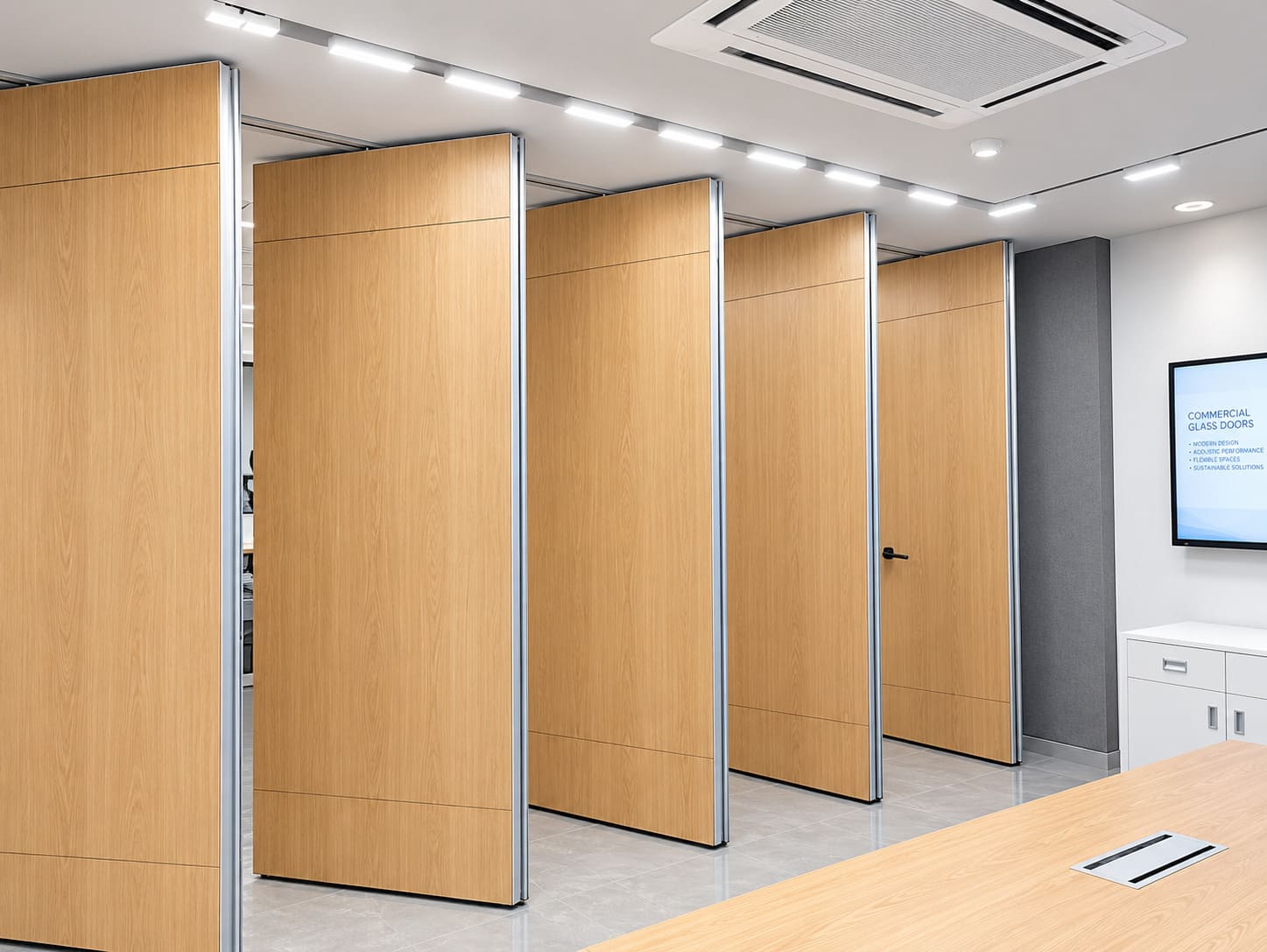
Envirotech provides acoustic sliding folding partition solutions designed to create flexible spaces while helping improve sound separation and privacy.
These movable partition systems are suitable for a wide range of applications, including:
- Offices
- Conference rooms
- Training centers
- Hotels
- Banquet halls
- Educational institutions
- Convention centers
- Multi-purpose halls
- Commercial spaces
Envirotech acoustic sliding folding partitions are available in different configurations based on project requirements.
The current Envirotech product range includes approximately:
85mm Acoustic Sliding Folding Partition
- Panel Thickness: 85mm
- Sound Rating: Approximately STC 40–45
- Suitable for flexible commercial interiors
- Ceiling-hung movable partition design
- Multiple surface finish options
100mm Acoustic Sliding Folding Partition
- Panel Thickness: 100mm
- Sound Rating: Approximately STC 45–50/51, depending on the selected configuration and project requirements
- Designed for applications requiring higher acoustic performance
- Suitable for larger and more demanding spaces
Available finishes can include options such as laminate, fabric, raw MDF, polyester board, grooved slats and lacquered glass, depending on the system and project requirements.
Where Are STC-Rated Acoustic Partitions Used?
Acoustic partitions with appropriate STC ratings are widely used in modern commercial and institutional buildings.
- Offices: Large office areas can be divided into meeting rooms, training rooms and private workspace. Acoustic partitions help improve privacy between these spaces.
- Conference Rooms: Multiple meetings may take place simultaneously in adjoining rooms. A suitable acoustic partition helps reduce interference between discussions.
- Hotels and Banquet Halls: Hotels often require flexible spaces that can be opened into one large hall or divided into several smaller rooms. Acoustic sliding folding partitions provide both flexibility and sound separation.
- Educational Institutions: Schools, colleges and training centers can use movable acoustic partitions to create adaptable classrooms and learning spaces.
- Convention Centers: Large convention and exhibition spaces often need to accommodate several events at the same time. Acoustic partitions help divide the space into functional areas.
- Multi-Purpose Halls: A single large hall can be quickly transformed into multiple usable spaces when required.
How to Improve the Acoustic Performance of a Partition
If high acoustic privacy is required, consider the complete system rather than focusing only on the STC number.
Important steps include:
- Choose the right partition thickness: Select a system suitable for your project’s acoustic requirements.
- Use effective acoustic seals: Proper top, bottom and vertical seals can help minimize sound leakage through gaps.
- Ensure professional installation: Correct installation is essential for performance.
- Consider surrounding walls and ceilings: A high-performance partition cannot fully solve a problem if sound easily travels around it through the surrounding structure.
- Evaluate the complete room design: For demanding projects, the entire acoustic environment should be considered.
Choose the Right STC-Rated Acoustic Partition with Envirotech
Understanding what STC rating means in acoustic partitions is essential when planning spaces that require both flexibility and privacy.
The right acoustic partition can help transform a large open area into multiple functional spaces while reducing unwanted airborne sound transmission between them.
However, choosing the correct solution involves more than simply selecting the highest STC number. Panel construction, acoustic seals, installation quality and surrounding building conditions all play an important role.
Envirotech offers acoustic sliding folding partition solutions designed for modern offices, hotels, conference rooms, educational institutions, banquet halls and other flexible spaces.
If you are planning a project and need the right balance of space flexibility, acoustic performance and modern design, Envirotech can help you select a suitable acoustic partition configuration based on your specific requirements.
Contact Envirotech today to discuss your acoustic partition project and find the right solution for your space.