Call Now!

Sliding Folding Partition vs Movable Wall: Which One Should You Choose?
Today, designers no longer design modern commercial spaces to remain the same forever. Similarly, offices need flexible meeting rooms. Hotels require adaptable banquet spaces, educational institutions need multipurpose halls, and conference centers divide large areas into several spaces.
Thus, Sliding Folding Partitions and Movable Walls become valuable solutions.
However, designers create both systems to enable flexible interiors without permanent walls. However, they are not exactly the same. Additionally, their operation, acoustic performance, panel configuration, storage requirements and ideal applications can differ depending on the system design.
So, Sliding Folding Partition vs Movable Wall: Which one should you choose?
The right answer depends on your project’s requirements for flexibility, sound insulation, frequency of operation and available space.
What Is a Sliding Folding Partition?
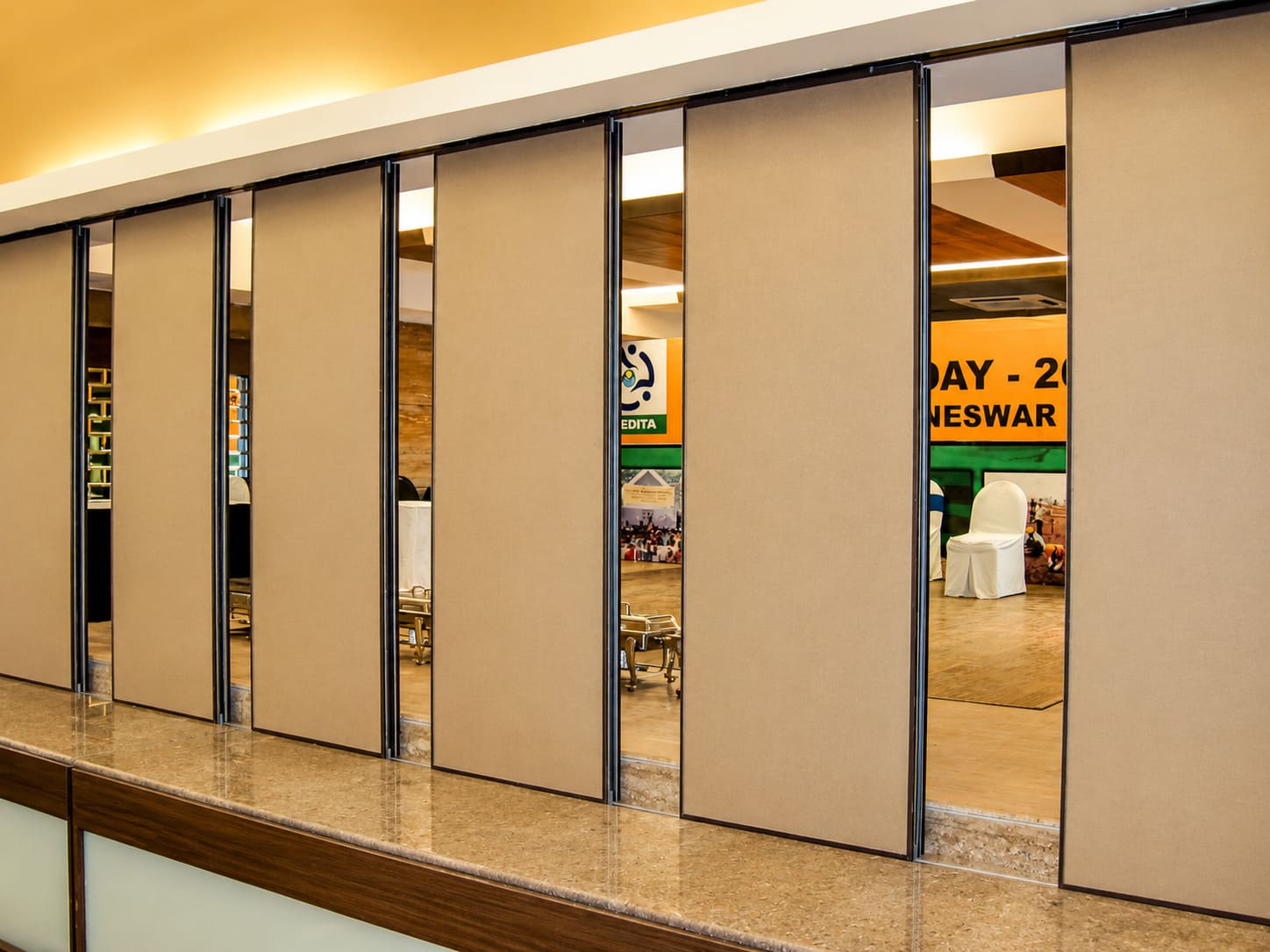
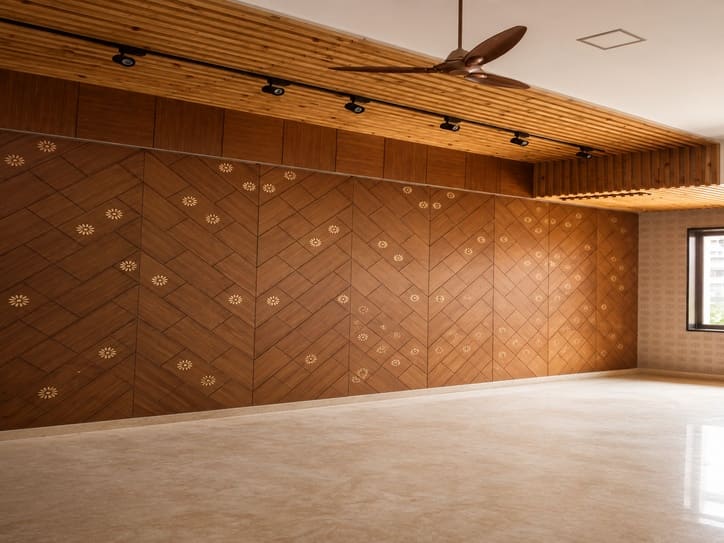
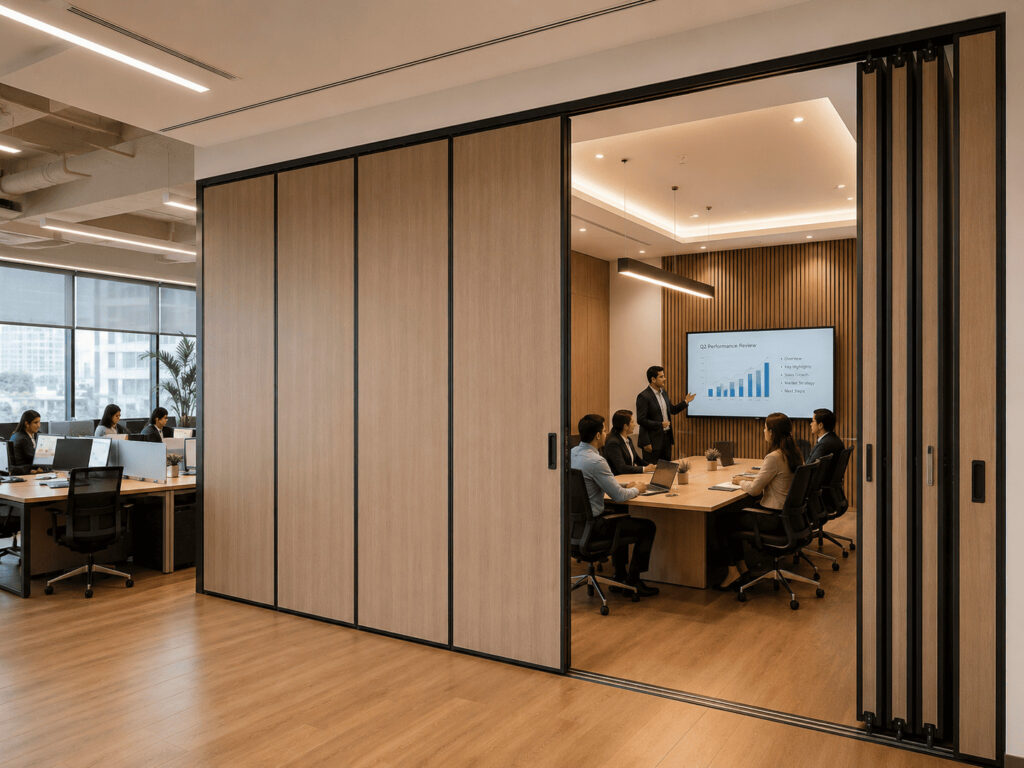
A Sliding Folding Partition consists of interconnected panels that move along a track and fold when opened.
When required, extend the panels across an opening to divide a large room into smaller functional spaces. When not required, the panels fold or park to restore the original open area.
People commonly use sliding folding partitions in:
- Offices
- Meeting rooms
- Conference rooms
- Hotels
- Banquet halls
- Educational institutions
- Training centers
- Multipurpose halls
- Commercial spaces
One of the biggest advantages of a sliding folding partition is its ability to provide maximum flexibility without permanent construction.
What Is a Movable Wall?
A Movable Wall, also known as an Operable Wall or Movable Partition Wall, is a system of individual panels designed to divide large spaces temporarily.
Unlike conventional fixed walls, movable walls can be opened, re-positioned and stored when the space needs to be reconfigured.
Many high-performance movable wall systems are designed with:
- Individual sliding panels
- Overhead track systems
- Acoustic seals
- Interlocking panel joints
- Floor and ceiling sealing mechanisms
- High-density acoustic cores
Movable walls are particularly suitable for projects where sound insulation and frequent space reconfiguration are important requirements.
Sliding Folding Partition vs Movable Wall: Key Differences
Although both systems provide flexible space management, their design and performance can vary.
| Feature | Sliding Folding Partition | Movable Wall |
|---|---|---|
| Primary Function | Flexible space division | Flexible space division with higher performance options |
| Panel Operation | Panels slide and fold together | Individual panels generally move independently |
| Storage | Folding or stacking arrangement | Individual panel stacking or parking |
| Acoustic Performance | Moderate to high depending on design | Often designed for higher acoustic performance |
| Panel Construction | Interconnected panels | Independent engineered panels |
| Applications | Offices, halls, meeting rooms | Hotels, auditoriums, conference centers |
| Flexibility | Excellent | Excellent |
| Customization | High | High |
| Cost | Depends on specifications | Can be higher for premium acoustic systems |
1. Panel Operation
One of the main differences between a sliding folding partition and a movable wall is how the panels operate.
Sliding Folding Partition
In a sliding folding system, panels are typically connected and move together. The panels slide along the track and fold or stack into a compact parking position.
This makes the system convenient for spaces that require quick and easy room transformation.
Movable Wall
Movable walls often consist of individual panels that move independently along an overhead track.
Each panel can be positioned individually and then connected to create a complete partition wall.
This configuration provides greater flexibility for larger commercial spaces and complex room layouts.
2. Acoustic Performance
If your project requires sound privacy, acoustic performance should be one of the most important factors when selecting a partition system.
Sliding Folding Partition
A standard sliding folding partition can provide basic visual separation and space flexibility.
However, Acoustic Sliding Folding Partitions are specially designed with features such as:
- High-density acoustic cores
- Interlocking panel systems
- Acoustic seals
- Top and bottom sealing mechanisms
- Precision-engineered joints
These features help reduce sound transfer between divided spaces.
Movable Wall
High-performance movable walls are often specified for projects where stronger acoustic separation is required.
They may include advanced perimeter sealing systems and heavier panel construction to improve sound insulation.
For spaces such as conference rooms, hotels, auditoriums and training facilities, acoustic performance should be evaluated based on the complete installed system—not only the panel itself. Proper sealing and installation significantly affect real-world sound reduction.
3. Space Flexibility
Both systems provide excellent flexibility compared with permanent walls.
Choose a Sliding Folding Partition If:
You want to quickly transform one room into multiple spaces.
For example: A large training room can be divided into two smaller classrooms and later opened again into one large hall.
Choose a Movable Wall If:
Your project requires frequent reconfiguration of larger spaces with independent panel movement and higher-performance specifications.
Movable walls are often used in:
- Large conference centers
- Hotels
- Convention halls
- Auditoriums
- Educational facilities
4. Storage and Parking Space
Before choosing either system, it is important to consider where the panels will be stored when the partition is open.
Sliding Folding Partition
The panels generally fold or stack together in a designated parking area.
This can be:
- Side stacking
- Center stacking
- Wall parking
- Custom parking configurations
Movable Wall
Individual panels are usually moved to a designated parking bay or storage location.
The available parking space should always be considered during the design stage.
A properly planned parking arrangement helps ensure smooth operation and prevents the partition system from interfering with the usable floor area.
5. Installation Requirements
Both systems usually require a properly engineered track system.
One of the most important considerations is the structural support above the partition.
The ceiling or supporting structure must be capable of handling the system’s weight.
Before installation, manufacturers and project teams should evaluate:
- Opening width
- Partition height
- Panel weight
- Structural support
- Track configuration
- Parking location
- Acoustic requirements
Professional installation is essential for smooth movement, correct alignment and long-term performance.
6. Applications
Best Applications for Sliding Folding Partitions
Sliding Folding Partitions are ideal for:
- Offices: Create flexible meeting rooms and collaborative spaces.
- Conference Rooms: Divide large meeting areas into smaller rooms.
- Hotels: Transform banquet spaces according to event requirements.
- Educational Institutions: Create classrooms, training rooms and multipurpose areas.
- Commercial Spaces: Improve space utilization without permanent construction.
Best Applications for Movable Walls
Movable walls are particularly suitable for:
- Auditoriums: Divide large areas for different events.
- Convention Centers: Create multiple event spaces when required.
- Hotels and Banquet Halls: Allow large halls to accommodate multiple functions simultaneously.
- Corporate Offices: Create private meeting and conference spaces.
- Educational Institutions: Transform multipurpose halls into multiple functional areas.
High-performance movable wall systems are commonly selected for demanding commercial environments where flexibility and acoustic separation are both important7. .
7. Design and Customization
Both Sliding Folding Partitions and Movable Walls can be customized according to interior requirements.
Depending on the system, available finishes may include:
- Laminate
- Fabric
- Veneer
- Raw MDF
- Polyester boards
- Grooved slats
- Lacquered glass
- Decorative finishes
Customization allows architects and interior designers to integrate the partition system with the overall design of the space.
Which Is Better for Acoustic Performance?
If acoustic privacy is your primary requirement, you should select a system specifically designed for sound insulation.
A high-quality Acoustic Sliding Folding Partition or Acoustic Movable Wall can provide significantly better performance than a standard lightweight partition.
However, acoustic performance depends on several factors:
- Panel construction
- Panel thickness
- Core material
- Vertical joints
- Top seals
- Bottom seals
- Perimeter sealing
- Installation quality
Even a high-performance panel may not deliver the expected results if gaps are present around the edges.
That is why it is important to choose a professionally engineered system with appropriate acoustic sealing.
Sliding Folding Partition vs Movable Wall: Which One Should You Choose?
Choose a Sliding Folding Partition When:
✔ You need flexible room division
✔ You want panels to fold or stack compactly
✔ You need quick space transformation
✔ You are designing offices or meeting rooms
✔ You want a customized architectural solution
Choose a Movable Wall When:
✔ You are dividing a large commercial space
✔ You require independent panel operation
✔ Acoustic performance is a major priority
✔ You need a premium operable wall system
✔ Your project involves hotels, auditoriums or convention spaces
Can Sliding Folding Partitions and Movable Walls Be Acoustic?
Yes, Both systems can be designed as acoustic partition systems depending on their construction and specifications.
Acoustic systems may include specialized seals, high-density cores and engineered panel joints to improve sound insulation between divided spaces.
For projects involving:
- Confidential meetings
- Training sessions
- Corporate offices
- Simultaneous events
- Hotels
- Conference centers
An acoustic specification should be considered during the planning stage.
Why Flexible Partition Systems Are Better Than Permanent Walls
Traditional walls are permanent. Once constructed, changing the room layout usually requires demolition, construction work, additional materials and significant time.
Flexible partition systems provide several advantages:
- Better Space Utilization: One large space can be transformed into multiple functional rooms.
- Lower Future Renovation Requirements: Layouts can be changed without constructing new walls.
- Faster Space Transformation: Rooms can be opened or divided according to operational requirements.
- Modern Interior Design: Custom finishes allow the partition to integrate with contemporary interiors.
- Improved Commercial Flexibility: Hotels, offices and institutions can use the same area for multiple purposes.
How to Choose the Right Partition System for Your Project
Before selecting a Sliding Folding Partition or Movable Wall, consider these questions:
1. How often will the space be reconfigured?
Daily-use spaces require durable and easy-to-operate systems.
2. How important is sound insulation?
If privacy is important, choose an acoustic-rated system.
3. How large is the opening?
Larger openings may require specially engineered panel and track configurations.
4. Where will the panels be parked?
The parking arrangement should be planned before installation.
5. What interior finish do you need?
Choose finishes that match the overall architecture.
6. What is your long-term requirement?
Consider how the space may be used in the future rather than only its current purpose.
Why Choose Envirotech for Sliding Folding Partition Solutions?
At Envirotech, we provide customized partition solutions designed to improve space flexibility, functionality and interior performance.
Our solutions are suitable for a wide range of commercial applications, including:
- Corporate offices
- Conference rooms
- Hotels
- Banquet halls
- Educational institutions
- Training centers
- Auditoriums
- Multipurpose halls
Whether your project requires a Sliding Folding Partition, Acoustic Sliding Folding Partition, or a customized movable partition solution, the right system should be selected according to your opening size, acoustic requirements, operational needs and interior design.
A professionally designed partition system can transform the way a commercial space is used—allowing one area to serve multiple purposes efficiently.
Choose the Right Partition Solution with Envirotech
Both Sliding Folding Partitions and Movable Walls are excellent solutions for creating flexible and functional commercial spaces.
Envirotech Sliding Folding Partition is an excellent choice when you need convenient space division, compact folding or stacking and easy room transformation.
A Movable Wall is often better suited to larger commercial projects where independent panel operation, advanced acoustic performance and premium specifications are required.
The best choice depends on your project’s space requirements, acoustic needs, frequency of use, panel parking space and interior design goals.
Before making a decision, it is always recommended to discuss your project requirements with an experienced partition manufacturer to select the most suitable system.
Transform Your Space with Envirotech
Looking for a customized Sliding Folding Partition or Acoustic Movable Wall solution for your office, hotel, conference room or commercial project?
Contact Envirotech Partitions to discuss your project requirements and find the right flexible space solution for your space.