Call Now!

Acoustic Partition vs Normal Partition: What’s the Difference?
When planning an office, hotel, conference room or other commercial space, partitions are often used to create separate areas without major structural changes. But choosing a partition is not only about dividing a room. In many environments, sound control and privacy are equally important.
This is where the difference between an Acoustic Partition and a Normal Partition becomes relevant.
A conventional partition is generally intended to create a physical or visual separation. An acoustic partition, on the other hand, is developed with greater attention to reducing sound transmission between adjoining areas.
Let’s look at the key differences and understand which type may be suitable for different applications.
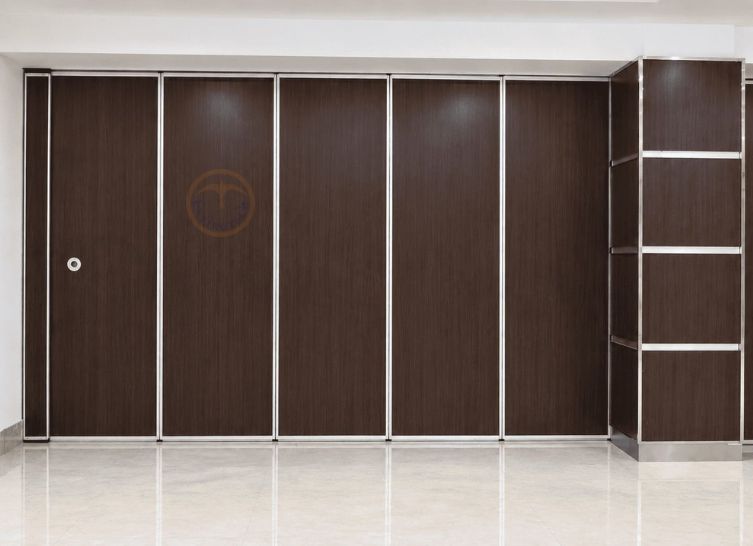
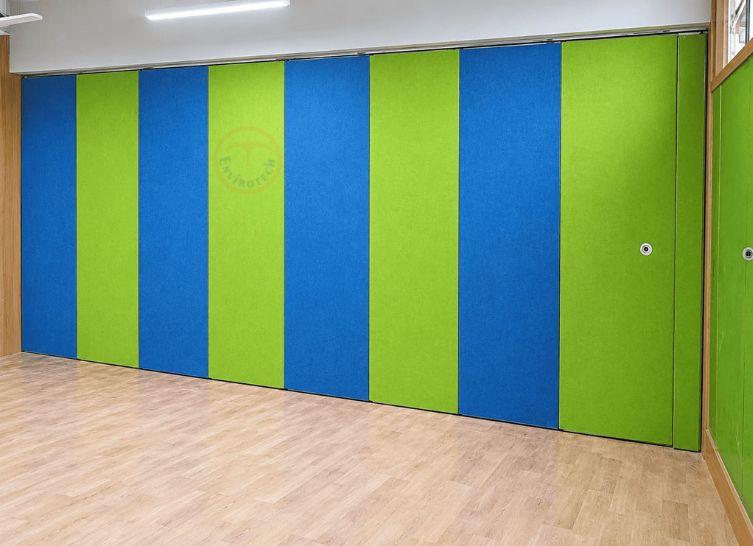
What Is a Normal Partition?
A normal partition is primarily used to organize an interior space.
It can be constructed using materials such as gypsum board, glass, wood, metal or other building materials. The choice generally depends on the architectural design, budget and functional requirements of the project.
A conventional partition can help with:
- Dividing large rooms
- Creating separate work areas
- Improving visual separation
- Organizing office layouts
- Defining functional zones
Although it can reduce some sound, sound insulation may not be its primary design objective.
For spaces where acoustic privacy is important, a standard partition may therefore require additional consideration.
What Is an Acoustic Partition?
Envirotech Acoustic Partition is designed with sound insulation as an important part of its overall performance.
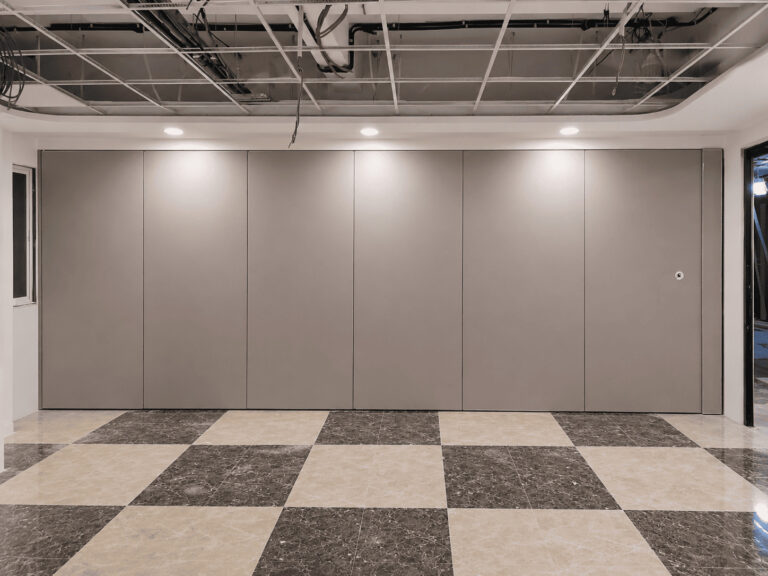
Its construction can include specially selected materials, panel configurations, joints and sealing arrangements intended to reduce airborne sound transmission.
Acoustic partitions can be useful in environments where people need to work, meet or conduct activities with less disturbance from neighboring areas.
Typical applications include:
- Corporate offices
- Boardrooms
- Conference rooms
- Hotels
- Training centers
- Classrooms
- Educational facilities
- Banquet halls
- Multipurpose rooms
The actual acoustic performance depends on the complete system, installation and surrounding building construction.
Acoustic Partition vs Normal Partition: The Main Difference
The simplest way to understand the difference is to look at their primary purpose.
A normal partition focuses mainly on dividing and organizing space.
An acoustic partition combines space division with sound-control requirements.
For example, a standard partition may work well for separating two general office areas where conversations between the spaces are not a major concern.
However, a meeting room used for confidential discussions may require a partition designed with greater attention to sound insulation.
Why Sound Control Matters
Noise can affect the usability of a commercial environment.
Consider an office where two meetings are taking place in adjacent rooms. If conversations from one room can easily be heard in the other, employees may become distracted and private discussions may lack the desired level of confidentiality.
Similar situations can occur in:
- Hotels: Different events may take place in adjoining rooms.
- Conference centers: Several meetings may run simultaneously.
- Training facilities: External noise can interfere with presentations.
- Educational spaces: Sound from neighboring classrooms can become distracting.
- Corporate offices: Private discussions may require better speech privacy.
An appropriately specified acoustic partition can help reduce airborne sound transfer between these areas.
What Makes an Acoustic Partition Effective?
Acoustic performance is influenced by the entire partition assembly.
- Panel Construction: The internal design and materials used within the panels can affect how sound travels through the system.
- Panel Connections: The joints between individual panels need to be carefully designed. Unwanted gaps can create paths through which sound can travel.
- Sealing: Top, bottom and perimeter sealing can help minimize sound leakage around the partition.
- Installation: Correct installation is essential. Even a well-designed acoustic system may not perform as intended if gaps or installation issues are present.
Therefore, acoustic performance should be considered as a combination of product design and installation quality.
Acoustic Sliding Folding Partition vs Conventional Partition
Some projects require both acoustic separation and flexibility.
In these situations, an Acoustic Sliding Folding Partition can be considered.
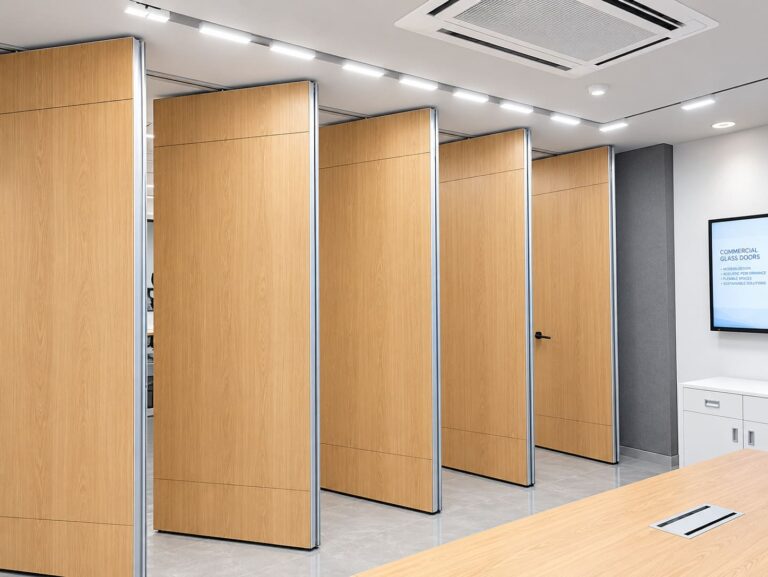
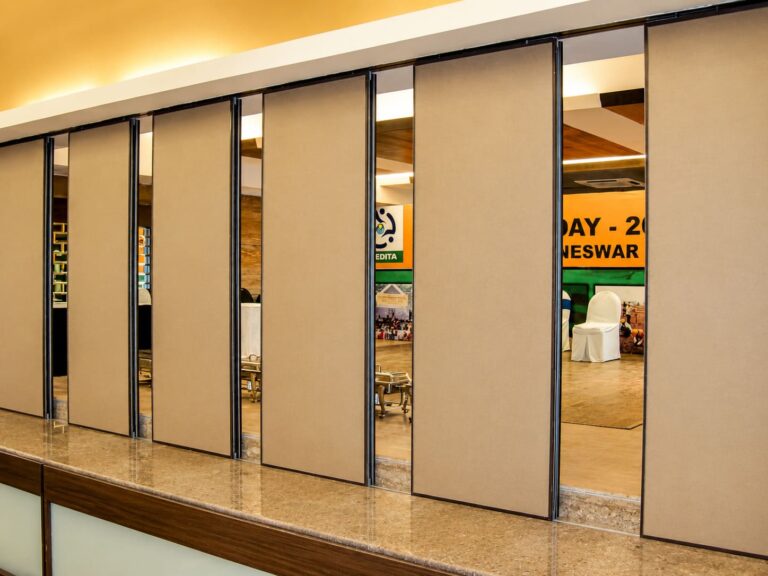
Unlike a permanent partition, a sliding folding system allows users to change the configuration of a room. When separation is required, the panels can be positioned across the opening. When an open area is needed, the panels can be moved towards their designated parking location.
This can be particularly useful in:
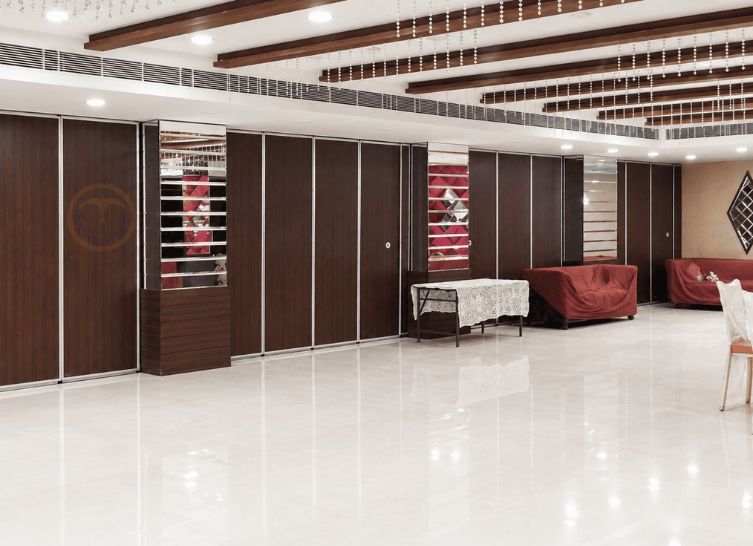
- Hotel banquet halls
- Conference facilities
- Training centers
- Corporate meeting areas
- Multipurpose halls
For example, one large hall can be divided into multiple smaller rooms for different activities and later restored to its original open configuration.
Is an Acoustic Partition Completely Soundproof?
An acoustic partition should not automatically be described as providing complete soundproofing.
Sound can travel through more than the partition itself. Ceilings, floors, adjoining walls, doors, service openings and other structural elements can create alternative paths for noise.
This is known as flanking sound transmission.
Consequently, a project’s overall acoustic design should be considered when high sound privacy is required.
How to Choose the Right Partition?
Start by identifying the purpose of the space.
A conventional partition may be sufficient when the main objective is simply to divide an area and provide visual separation.
An acoustic partition may be more appropriate when the project involves:
- Confidential meetings
- Simultaneous activities
- Speech privacy
- Noise-sensitive work areas
- Conference rooms
- Hotel functions
- Training sessions
Other factors such as partition operation, available space, panel parking, appearance and maintenance should also be evaluated.
Acoustic Partition Solutions by Envirotech
Envirotech Partitions provides customized partition solutions for commercial and architectural applications.
Our solutions can be considered for offices, hotels, conference facilities, educational institutions, training spaces and multipurpose environments.
Depending on the project requirements, options can include Acoustic Partitions, Sliding Folding Partitions and Acoustic Sliding Folding Partitions.
The appropriate system should be selected after considering the space, its intended use and the required acoustic performance.
Which Partition Is Suitable for Your Space?
The difference between a normal partition and an acoustic partition is primarily related to their intended performance.
A conventional partition is mainly used for space division and visual separation, while an acoustic partition places greater emphasis on reducing airborne sound transmission and improving privacy.
If sound control is an important requirement, it is worth considering the partition construction, joints, sealing, installation and surrounding building elements—not just the appearance of the panels.
For flexible commercial spaces, an Acoustic Sliding Folding Partition can combine room reconfiguration with sound-control considerations.
Ultimately, the right solution depends on how the space will be used and what level of privacy and flexibility the project requires.